

This Week In Slop
Artificial abounds. Keeping an eye out for the intelligence.

LET’S START WITH SOME GOOD NEWS. Profoto doesn’t think you need to buy expensive strobes any more — or really any sort of lights, light modifiers, cameras, or anything at all except for a subscription to a water-eating shortcut machine. Think of all the money you’ll save!

I am incredibly curious about the behind-the-scenes conversation going on down at the strobe factory.
“Hey, should we promote a technology that will at best undermine and at worst cause direct harm to our business?”
And after that surely thoughtful-and-at-times-heated discussion they decided… yes?1 Either that or some social media intern got in big trouble.
SPEAKING OF PEOPLE ABSOLUTELY NOT GETTING IT while 100% for sure arguing I’m the one who doesn’t get it… The great and talented director (of such films as Requiem for a Dream, The Wrestler and Black Swan) Darren Aronofsky is releasing a series of AI-generated videos about the American Revolution. My initial reaction was to dismiss them out of hand but I decided that was unfair and I should give them a fair assessment, especially since they originate from such a gifted artist. So I queued up the first one and made it exactly 15 seconds before aborting the mission and flushing my eyeballs with lye. It’s just not good in any of the ways that have ever defined something’s ability to be good. Other than that it’s fine. It likely would’ve been just as effective if he’d taken whatever script he’d written2 and overdubbed it onto an old episode of Paw Patrol. How is this shite supposed to be progress?
We’re only a few bites into this shit sandwich and I’m already full.
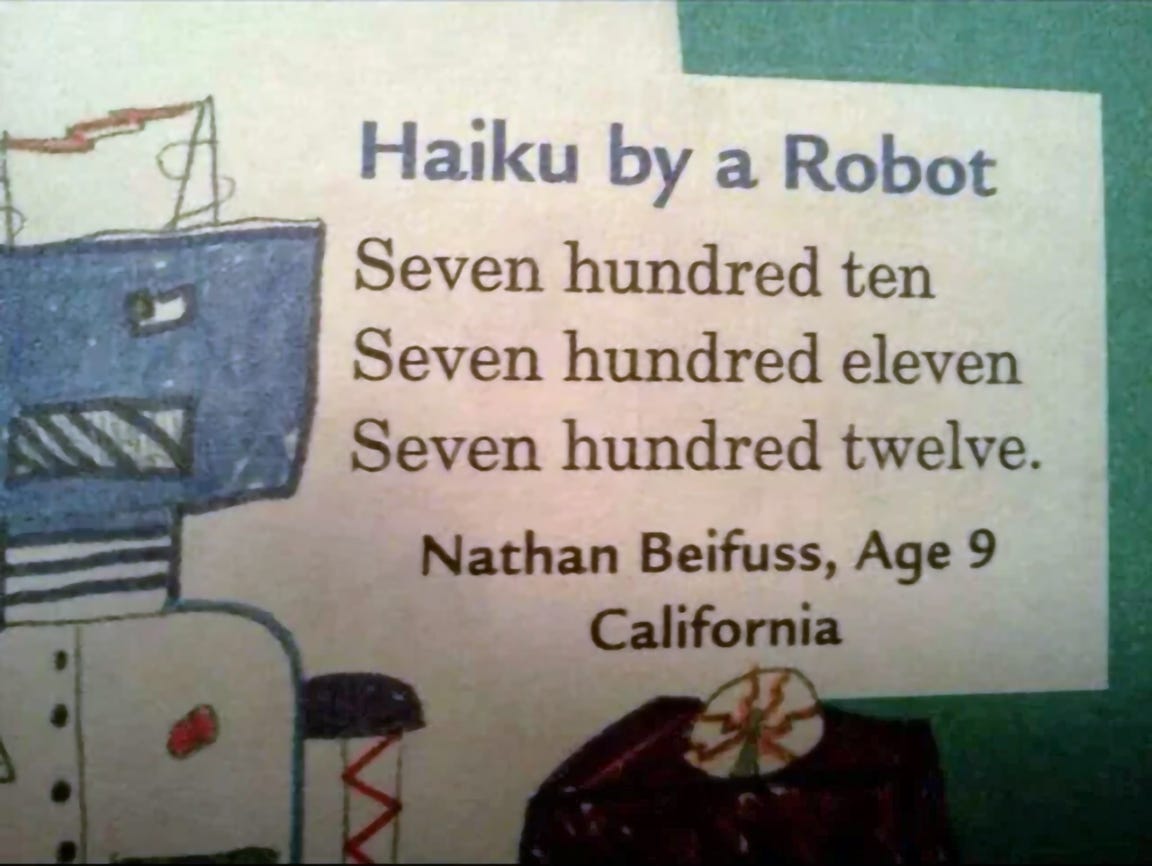
THE FOLLOWING HAIKU was purportedly written by a nine-year-old kid, published in Highlights magazine around a decade ago. It’s a brilliant critique of AI art, if you ask me.
HAIKU BY A ROBOT
Seven hundred ten
Seven hundred eleven
Seven hundred twelve.
Thank you, Nathan Beifuss, 9-year-old Californian. I hope the adults in your life recognize your genius.
HOW ABOUT SOMETHING SO PREPOSTEROUS you’re sure to believe it was made up by a machine? But no, in fact, everyone’s favorite [redacted] created what many suspect was initially intended to be an advertisement promoting the purported benefits of drinking raw milk (until, presumably, the lawyers said, umm, if you want to keep any of your money don’t do that). So now it’s a commercial for whole milk which, fine, do your thing. But proving once again that AI is the shyster’s favorite shortcut machine… the commercial doesn’t feature real children drinking real milk but rather AI renderings of distraught children sadly drinking AI rendered cow beverage.

I’m growing tired of trying to figure out how to explain to people why this is terrible. I guess just watch it again and if it still doesn’t click keep doing it until you seize.
I’M A KNOWN FAN of Ryan Broderick’s Garbage Day newsletter,3 and a recent post reaffirmed why. Not only does he confirm my growing suspicion that a lot of AI is simply a waste of time, but he’s reached the same conclusion I have: AI isn’t a revolution in computing, it’s a revolution in accepting lower standards.4
“I have tried over the last few years to thread a somewhat reasonable middle ground in my coverage on AI,” Broderick writes. “Instead of immediately throwing up my hands and saying, ‘this shit sucks ass,’ I’ve continually tried to find some kind of use for it. I’ve ordered groceries with it, tried to use it to troubleshoot technical problems, to design a better business plan for Garbage Day, used it as a personal coach, as a therapist, a video editor. And I can confidently say it has failed every time. And I’ve come to realize that it fails in the exact same way every single time. I’m going to call this the AI imagination gap.”
“Every time I’ve tried to involve AI in one of my creative pursuits it has spit out the exact same level of meh,” he continues. “No matter the model, no matter the project, it simply cannot match what I have in my head. Which would be fine, but it absolutely cannot match the fun of making the imperfect version of that idea that I may have made on my own either. Instead, it simulates the act of brainstorming or creative exploration, turning it into a predatory pay-for-play process that, every single time, spits out deeply mediocre garbage. It charges you for the thrill of feeling like you’re building or making something and, just like a casino — or online dating, or pornography, or TikTok — cares more about that monetizable loop of engagement, of progress, than it does the finished product. What I’m saying is generative AI is a deeply expensive edging machine, but for your life.”
“If AI succeeds, we will have to live in a world where the joy of making something has turned into something you have to pay for. And if it really succeeds, you won’t even care that what you’re using an AI to make is total dog shit. Most frightening of all, these AI companies already don’t care about how dangerous a world like this would be.”
In addition to the plagiarism and the water and the terrible output and the job loss and the inherent cheapness… add this to the pile of reasons to be suspicious of AI.
REMEMBER WHEN in my predictions for 2026 I said we’d come up with some sort of content verification system? Well can somebody who makes technology get on with it already? Either the social apps or the camera makers or just, you know, one of the many billionaires profiting off our precipitous societal decline?
Because it’s been an awful couple weeks. For starters there was this, the first known instance of “an official social media account representing the government of a democratic nation intentionally spreading altered imagery maliciously targeting one of its own citizens.”

Then, mere days later, an AI-enhanced photo of ICE victim Alex Pretti was aired by major news outlets including MS NOW, Daily Mail and International Business Times.
At a time when basic truths are convincingly disputed by the malicious and dimwitted, it’s more important than ever that we reinforce the baseline standard of truth in journalism. Once again, AI imagery adds to chaos and subtracts from quality.
HERE’S A GOOD VIDEO about why average isn’t interesting. “Everything you make is the result of whatever it is you’ve experienced and distilled into your own taste.” (Thanks Corey!)
THE TECH BROS MAY WIN. It might be inevitable. But that doesn’t mean I shouldn’t keep shouting as we hurtle into the abyss.
These are the actions of someone who hasn’t yet seen their industry decimated in short order and perhaps doesn’t believe it to be possible. If you wonder why so many writers and photographers are skeptical of AI, take a look at how social media utterly flattened their industries over the last 100 months. It can and does happen, quickly, and y’all out here thinking it’s neato to get a cartoon of your face on a hot Santa body you can share on LinkedIn. Jeebus.
Who am I kidding. Whatever script the AI generated.
We superfans refer to ourselves as “Grouches” after that famous Sesame Street garbage dweller.
Remember “AI isn’t better, it’s just faster?”
I just can’t understand profoto! They had their market share eroded for the last decade by cheaper Chinese gear and now this?
AI Without Warning.
I recall an incident with a visiting guest Graphic Designer/Illustrator. We were building a set, and he commented on the light and shadow. My response was "well, as an illustrator you can put the shadows wherever you want, regardless of reality." Illustration can create its own universe with its own rules. Due to its clearly artificial nature, we can suspend disbelief and experience the message.
My motto for my photo department is: It's all about the light. In my Introduction to Digital Photo and Introduction to Professional Lighting any assignment was most generally expressed through the basic rules of how light behaves. Further, I reinforced the effect of lighting and how it affects the human brain.
Once past the basics of photo, one can see clear of a learners befuddlement with the process enough to realize that the brain reacts to things that aren't right. Knowing that, we make our mechanical adjustments to insure good capture.
That said, the brain has evolved to make adjustments so it can receive the light, identify it, accept its deficiencies, and accommodate, and move on. The easiest model is with light color; blue shadows get warmed up after a few moments. Awful fluorescents balance after a bit. It happens so often we aren't aware of it.
For me AI is like the Illustrator but the imaging it presents has a greater verisimilitude than pure Illustration. The brain corrects the weirdness, suspending disbelief, and we move on...unless you are cursed with photographic expertise. Toy Story? We know going in that it is computer generated so in we dive and enjoy.
AI, thus far, promotes an ideal, it need not adhere to physics. We aren't given the choice to know it is artificial and untrue. It leaves me uneasy. Traditionally-based photographers promote what is real, without apology.