

On the Creative Disengagement from Logic
Part One: Not everything requires a diagnosis.

I have this theory — it’s not exactly original, but I’m claiming it nonetheless — that logic and art are generally opposed.
By which I mean: I stifle my openness and creativity by prioritizing logic in a system that doesn’t require it.
“Why make that red?” I might ask myself. “Shouldn’t it be blue to coordinate with the other thing?” Maybe it should. But what was the urge to make it red? What if I just… made it red? That could work. Do I really need a reason?
I think this is found within the impetus of a lot of great works of art — from poems to songs to paintings. Not asking “why?” but asking “why not?”
I think other people believe this too, as evidenced by their completely opposite approach.
This need for logic, I believe, is at the core of “I could’ve done that” commentary uttered by grumpy people confronted with contemporary paintings they don’t understand. From Rothko to Warhol, Twombly to Basquiat, they don’t understand it because it’s illogical and, ergo, not good.
This inability to appreciate technically unimpressive art, I believe, is tied to a search for meaning via logic.
“What is it?” they ask (or indignantly insist).
If it doesn’t make sense, our brains suggest, dismiss it. This is the voice of reason, the logical brain making meaning by finding order.
Which is all fine and good, in the grand scheme of things. Like what you like. But, speaking for myself, I believe that when I can get past my need for logic, a whole world of appreciation opens up. Suddenly I find myself responding positively to some piece of art even though I can’t explain why. I don’t understand the lyrics but I love the song. Instead of hearing or seeing or tasting and saying, “I don’t understand this so I don’t like it” I can instead say, “I don’t understand it and I wonder why.”
Lack of curiosity has killed an awful lot of wonder. Stamped it right out.
Explanations. Categorizations. Quantifications. These are the products of the logical mind. Essential for some things, sure. But not for every thing. Certainly not for pictures on a wall.
I credit Rick Rubin for opening my eyes to this way of thinking.1 His book, The Creative Act, helped me get a handle on a type of openness I’d been dabbling with but had never quite fully understood. Such openness facilitates both the creation — and appreciation — of art.
Ignoring logic and engaging with your lizard brain can open one up to a wide variety of artistic experiences — not the least of which being a simple appreciation for our reaction to how a work of art makes us feel regardless of what it makes us think.
So what if the lyrics don’t make sense. So what if it’s just a painting of an orange square beneath a purple rectangle. If it causes you to feel something — anything — it’s working.
Not everything needs a diagnosis. Certainly not art.
But what about the making of art? How do you get past the hurdle of logic when it comes to spending your time making things?
I have mostly gotten past my default inability to appreciate seemingly illogical works of art. My favorite is a recreation of an old garage in a third floor gallery at the Los Angeles County Museum of Art. It’s called Central Meridian. It’s a recreation of a mid-century garage filled with peculiar tchotchkes and assorted ephemera, and it doesn’t make any sense at all. But goodness does it fill me with wonder and delight.
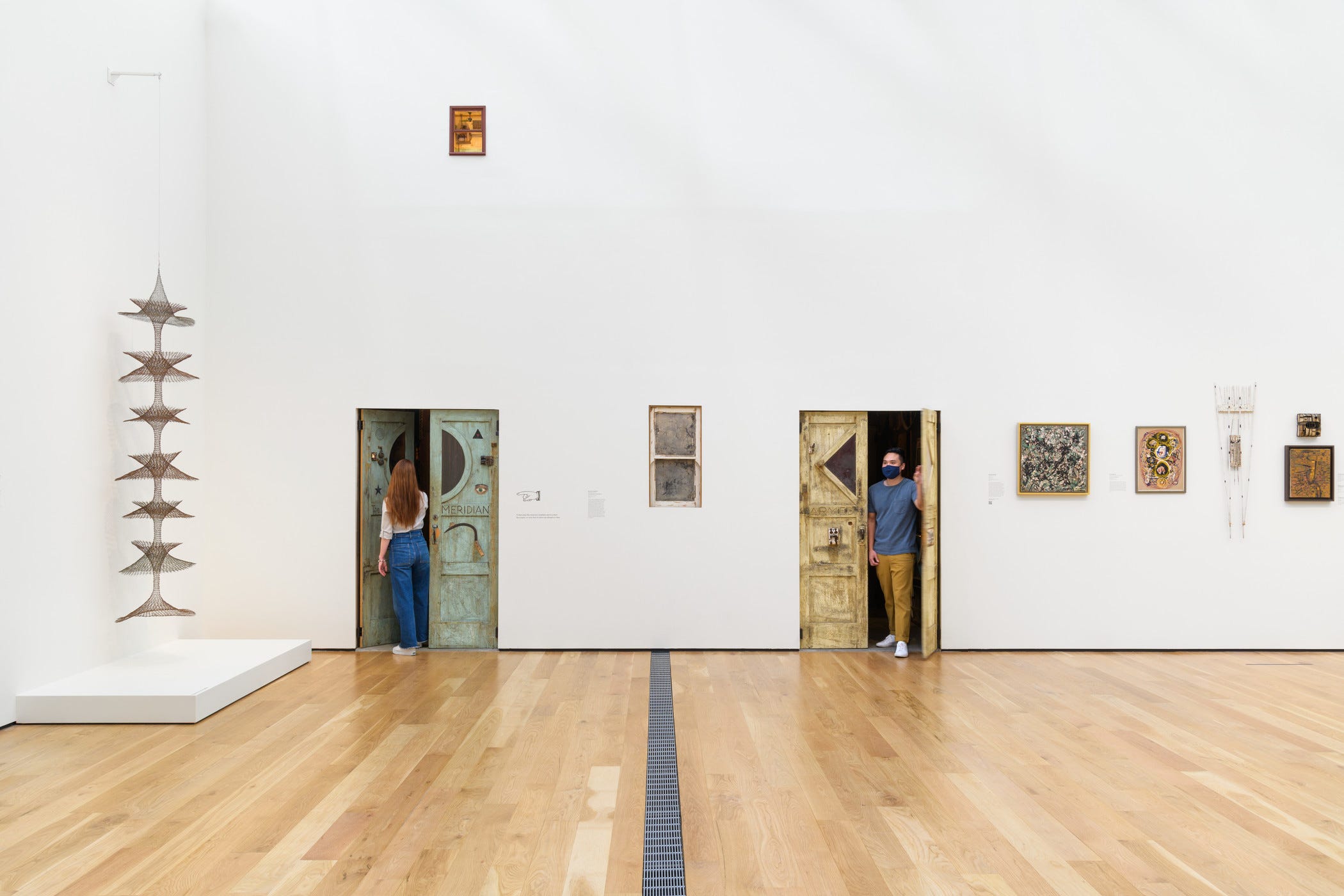
No matter how good I’ve become at appreciating the illogical, I still find when it comes to doing (making things, being creative) my logical brain starts getting pushy.
“Why should I do this?” I ask myself. And if I don’t provide a good answer I remain seated instead of doing the thing that might have brought me illogical joy.
Some folks are better at getting beyond the doubter in their heads. These people are called “artists” and I think we can learn a lot from them.
In Jeff Tweedy’s book How to Write One Song he explains his version of this — an echo of my own theory — when he discusses doing whatever it takes to get the melody out, even if it means constructing phrases that may seem like gibberish.
“Our thinking and the way we communicate can be very rigid, and words just bounce off the surface tension of our overtaxed attention. This is all fine and natural for our day-to-day communication needs. But in order to write songs, most of us direct some intention into the mix to free language from those needs and allow it to reveal beauty and pain, or whatever else is hiding beneath the outer layers of everyday language.”
What a beautiful sentiment. Sometimes, I suspect, Mr. Tweedy especially relishes the most obtuse lyrics. If they work, they work. What an achievement it is to communicate profound emotion through what seems like utter nonsense. It’s especially effective, in my opinion, precisely because it is disconnected from logic. How else do you explain lyrics like “I am an American aquarium drinker, I assassin down the avenue” or “I attack with love, pure bug beauty, I curl my lips and crawl up to you.”
Tweedy is an acolyte of Bob Dylan, the master lyricist who set the standard for effective illogic.
“Darkness at the break of noon, shadows even the silver spoon, the handmade blade, the child’s balloon, eclipses both the sun and moon, to understand you know too soon, there is no sense in trying.”
If it works it works. Logic be damned.
In an effort to keep this comfortably readable… This concludes part one of my two-part essay on the importance of eschewing logic in artmaking. Tune in next week for part two, which I like to think of as a fantastic payoff.
Insert eyeroll here if you must. But I’m telling you, that book changed my brain! His recent essay on the subject touches on this too. And I mean I feel it in my bones! “Creative is something you are, not only something you do. It’s a way of moving through the world, every minute, every day.”
Logic is a device, a fabricated tool. All of the formatting tools, like the Golden Whatever, Rule of Thirds...ad nauseum are tools as well. Like all tools, including language, text, and speech, it approximates what the brain "sees" expressed by charges in axions, which developed long before any of this communication stuff. That doesn't mean that the brain does not understand but does mean that understanding precedes the aforementioned tools. I imaging that understanding developed well after instinct.
I seldom use logic to understand my visions. I work from the gut, excepting client demands. ;)
Bill, being a logical, mathematical, yet artistic person, I recommend considering what you’re addressing in the post in context of Information Entropy. From that, add the utility of complexity. The purpose is to connect artistic and mathematical dots between the domains.
In my view, the best art has fundamental structures. Jackson Pollock’s paintings are measurable in contrxt of fractals, as an example. There are all sorts of implications if you follow this logic trail as a cross-domain art & math agent. Cheers!