

Traveling Light
Everything’s bigger in Texas — except for my lighting kit

I secured an all-too-elusive traveling assignment recently. My commercial concentration is corporate portraiture, and while that’s not the kind of thing that plays well on social media,1 I really love it. I meet interesting people every day and get to pick their brains about their passions and expertise for 6 to 60 minutes at a time.
Post-pandemic, most of my travel is regional — drivable distances a few hours at a time. The nice thing about driving to a gig is you can load up the van with all the same junk you’d take across town. So you can have all the stuff you know you’ll need, the stuff you think you might need, and some other stuff just in case.
But when you’re boarding an aeroplane it isn’t quite so simple. Especially if you want to travel light. I like to do that, because it takes a string of tiny trips to get anywhere: home to parking, shuttle to terminal, bag check, through security and to the gate, from the gate to seat 5C, up and down to Dallas, seat 5C to baggage claim, hike a mile to the remote rideshare pickup spot, Uber 30 minutes at 125-miles-per-hour to the hotel, to the front desk, up to the room, finally arriving at the location where you’ll get out the camera. Then reverse it all when it’s time to go home. Each of those stages represents a confrontation with baggage, so I find less is most definitely more.
If you’re traveling with a crew, of course, you can divide a dozen cases and bags between a handful of people and keep the heavy lifting — as well as the baggage fees — to a minimum. But when I’m being a one-man-band, I don’t like to burden myself with more gear than I know I’ll need.
This desire to travel light conflicts with another of my closely held beliefs: the importance of backups. “Two is one and one is none,” is a mantra of mine. I believe it wholeheartedly, just like I have faith in Murphy’s Law. I’m running a business here, so I carry two cameras because I want to get paid. If one camera breaks, I can keep working. Same goes for lenses, batteries, SD cards, strobes, triggers, cables, et al.
The secret is to ensure you can do the job even if the airline loses your bag. So when I fly, my carry-on is a smallish shoulder bag stuffed with the bare minimum necessary to do the job.
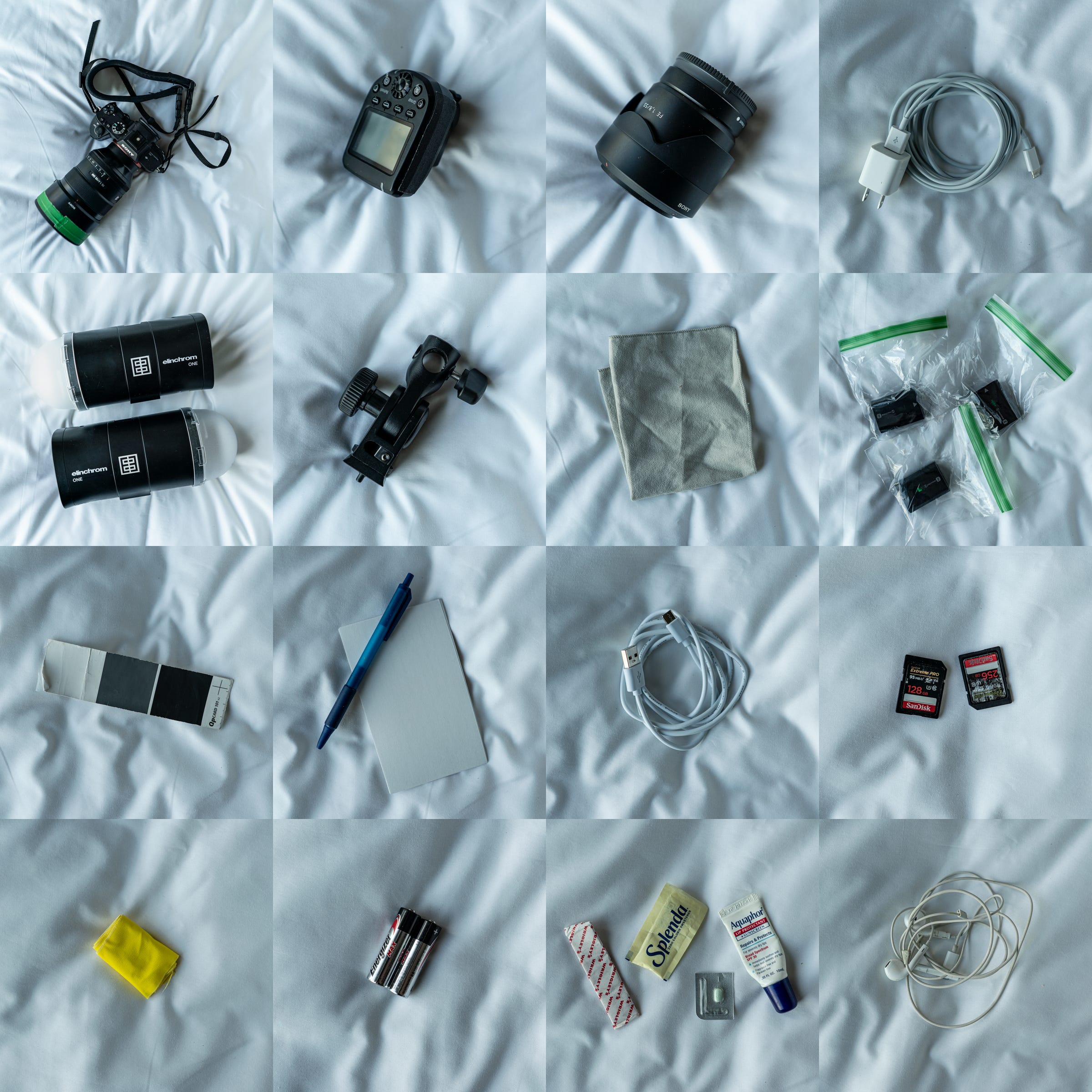
For this week’s trip to Dallas, that meant my shoulder bag held the following:
• 85mm lens2
• 55mm lens (in case the 85 was too tight for a location I hadn’t seen)
• five camera batteries (two in camera, three spares individually wrapped because I’m a rule follower)
• two monolight strobes3
• strobe bracket
• radio transmitter
• extra AA batteries for the transmitter
• gray card
• pen and paper
• phone charger
• USB-C cable
• four SD cards (2 in camera, 2 in bag)
• gaff tape (little wadded up roll, plus a few strips strategically adhered to the bag)
• ear buds
• lens cloth
• lip balm
• chewing gum (one stick, Big Red)
• Immodium pill (you never know)
• one packet Splenda (for coffee, because you never know)
Late additions to the above included a banana and a granola bar4 in case I didn’t get lunch, which I didn’t, so good thing.
The only reason I was able to travel light was because of the light. This particular client prefers natural light for their portraits. So I take strobes only in case I wind up working in a cave, which happens roughly one quarter of the time.
This is also the reason why I didn’t simply hire a Dallas-based assistant and rent their lights. Nine out of ten times that would’ve been the move, but given the very specific style this client prefers, I was willing to risk it.
I could’ve carried out the shoot, in a pinch, with nothing more than the camera and the lens. In the checked bags, though, there was more good stuff that I did end up using. A pop-up diffuser (roughly 5x7’) a pair of light stands, an arm to hold the diffuser, two Pony clamps, quarter- and half-CTO gels, an empty reusable grocery bag (to be filled with water bottles acquired on site for use as a sandbag) and a shoot-through umbrella. I used almost all this stuff.
After spending the afternoon of my scout day trying to find just the right spot, the plan was upended on the morning of the shoot when my client greeted me with every photographer’s favorite phrase: “Slight change of plans.”5
Turns out this change was no big deal. Interestingly, though, the area we’d scoped out was off limits, because the hotel was so desirable ¯\_(ツ)_/¯ that they actually charged extra to take pictures in the atrium. (Even if, apparently, your company is renting several meeting rooms as part of a two-day conference.) Thankfully the corner in which they shoved us managed to be simultaneously out of the way while not so far from the meeting that subjects would get waylaid on their way to the spot.6 Best of all, though, the location was backlit with beautiful morning light. A natural edge and a bit of sparkle on the concrete, glass and fiddle leaf fig in the background.
All this backlight meant I needed a whole new key. A bounce could’ve worked in a pinch, but I went with an umbrella’d strobe straight through the diffuser for a soft key that still had direction. I handheld the second monolight for on-axis fill — my top secret tip for adding production value to any portrait. It was a bit of a handful, but it worked really nicely for a minimalist approach.
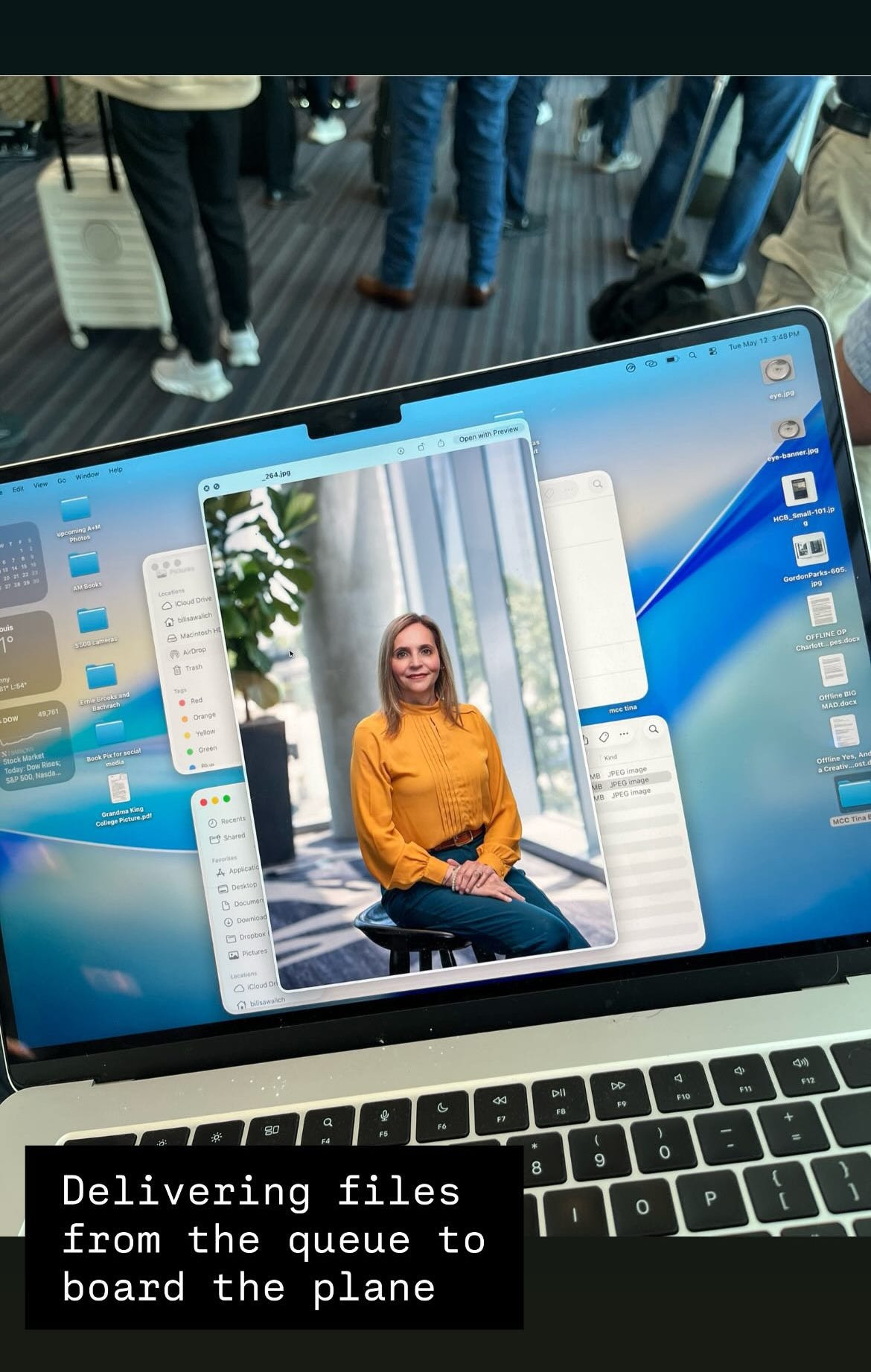
After all was said and done we did ten portraits in a quick little window and I managed to deliver a couple of crucial selects while in line to board the plane. I was even able to catch an earlier flight home. Not quite in time for dinner, but close.
Some part of my brain really enjoys the puzzle-like challenge of tackling logistics. Solving the riddle with some scrappy ingenuity (luggage as counterweight, for instance) and ultimately doing more with less. It’s something I’ve been trending toward in my portrait lighting for quite some time anyway, so having a practical reason to keep it simple amounts to an excuse to work in the way that I like.
Younger me relished the idea of a big production with a dozen different lights and a forest of C-stands manned by a flock of assistants. Middle-age me really likes the idea of self sufficiency, keeping it simple without compromising the results. This was a fun exercise in putting theory to the test in the real world and, blessedly, it meant the travel was not remotely the most challenging part of the job.
Except for LinkedIn, but who wants to be popular there?
Those who know are cackling at the obviousness of this lens choice, since it rarely comes off my camera.
With integral Li-Ion batteries that can’t be checked anyway.
Candy bar in disguise.
Only surpassed by “Let’s shoot it both ways.”
This is, surprisingly, a consistent issue. People can use the least bit of friction as a karmic excuse to skip their photo shoot.
YESSIR! For several years I did an annual 30-Under-35 feature for a trade mag. 30 subjects in almost 30 cities across the US (and sometimes Mexico and Canada) in about 3 weeks. Solo. Traveling light was 100% mandatory. For the flights I figured out how to carry on a small backpack with laptop/2 bodies/lenses and an overhead-sized Pelican roller with a couple collapsible modifiers, speedlights and nano stands and a few clothes stuffed inside. It was quite the exercise in “jazz photography” at each location, walking into a totally foreign setup with two bags and making it work with what I had. And it almost always worked out great. I totally have that small part of my brain that loves it too.
The, "slight change of plans" line always sends a shiver through my insides, so I now understand the inclusion of the Immodium. I understand the need to sometimes travel past the usual distances, and that air-travel is perhaps the only way to get where you need to go, but I try to avoid the airline industry as much as possible. Having travelled to gigs by aeroplane, I can appreciate your packing strategy, especially your reasoning.