

Taken By Storm
Inspired by Ansel Adams’ grand landscapes, Mitch Dobrowner blends traditional black-and-white skills with digital tools and an affinity for finding the most dramatic weather on earth

When the last of the photo magazines folded and their websites went dark, hundreds of features and profiles disappeared. In an effort to preserve some of this work, I plan to repost occasional pieces here at Art + Math. The following interview was originally published in Outdoor Photographer magazine in March 2015. All photography by Mitch Dobrowner.
In an age when black-and-white landscape photography is too often considered anachronistic, photographer Mitch Dobrowner literally never wavers from his monochromatic view of the world, as he makes images literally unlike any that have come before. To call him a landscape photographer may be technically accurate, but it doesn't do justice to the one-of-a-kind, jaw-dropping images that have taken a prominent place in his portfolio. Dobrowner is a storm chaser.
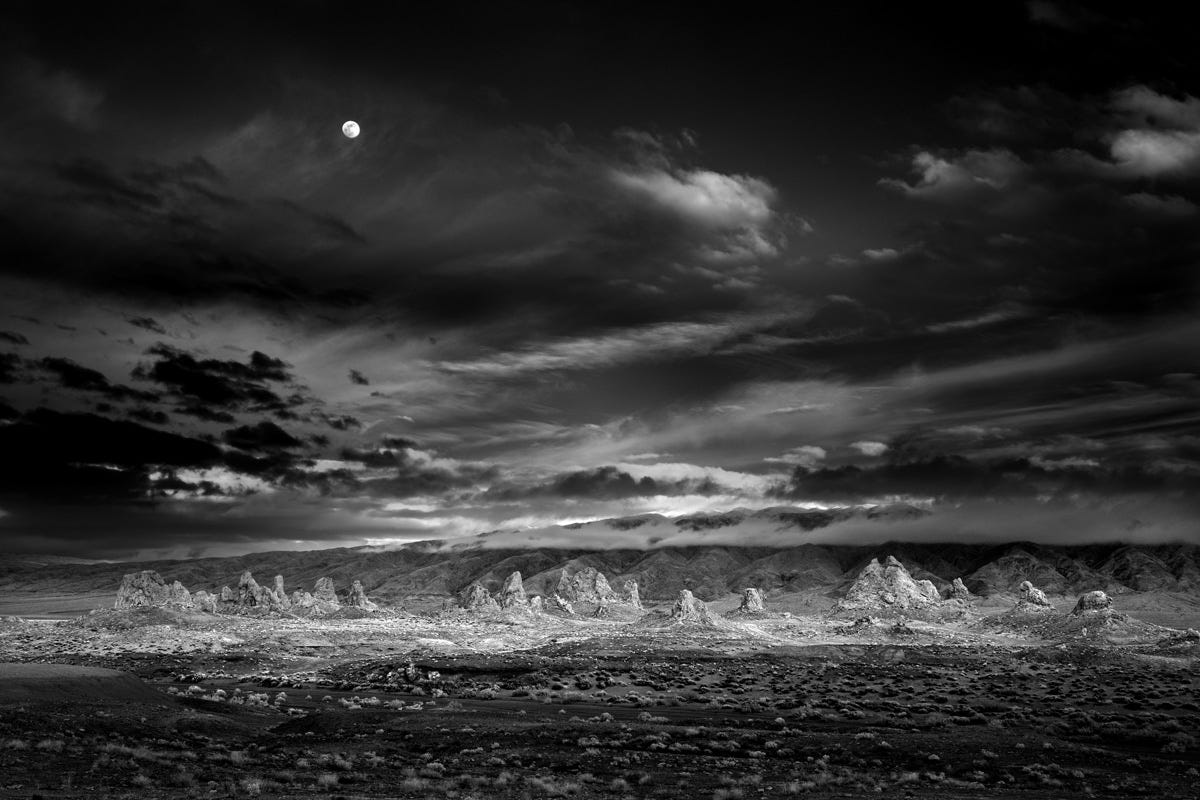
"I always found myself photographing in really inclement weather," he says. "It was just so beautiful to me. In that weather, you never really knew what was going to happen. I would go out to the Southwest in the winter and it just came to my mind that if I'm enjoying this weather... I heard about all the action in Tornado Alley, so I just went out as an experiment. I had no idea what I was going to see. It blew my mind.
"One of my friends hooked me up with a storm chaser," he says, "and I flew out to Rapid City, South Dakota. The first three days I just couldn't believe what I was looking at. That's honest: I couldn't believe what I was looking at. It was like, oh, this is more than an experiment. This is now a project."
Dobrowner first took up photography in his teens and quickly found inspiration in the work of Ansel Adams, an influence that still shows in his prints today. At 21, he spent four years deliberately emulating Adams, traveling the Southwest and working out of his car while shooting large-format sheet film. A career change, a family and a couple of decades later, Dobrowner returned to photography in 2005 and has been chasing storms since 2009.
Early training in sensitometry and the inspiration of Adams remain with Dobrowner even today, as he uses a Canon DSLR like a view camera. Live View stands in for ground glass, and he filters the lens for total tonal control.
"I haven't pushed the 5D Mark II to its max yet," Dobrowner says. "When I feel like I have, then I'll move on. I came from a 4x5/8x10 background. My bibles were Adams' books The Camera, The Print and The Negative. I really see the sensor acting just like a film plane. With Live View, I can see the direct feed off the sensor. So if I put a red filter in front of it, it gives me a really close idea of how it's affecting what I'm going to capture. I've taken off anti-aliasing filters, and I've done experiments with red filters, blues, greens, polarizers, I've had filters built that are blocking filters—I really just see the camera body as kind of a paintbrush, and I don't want the camera manufacturers to tell me how to paint.”
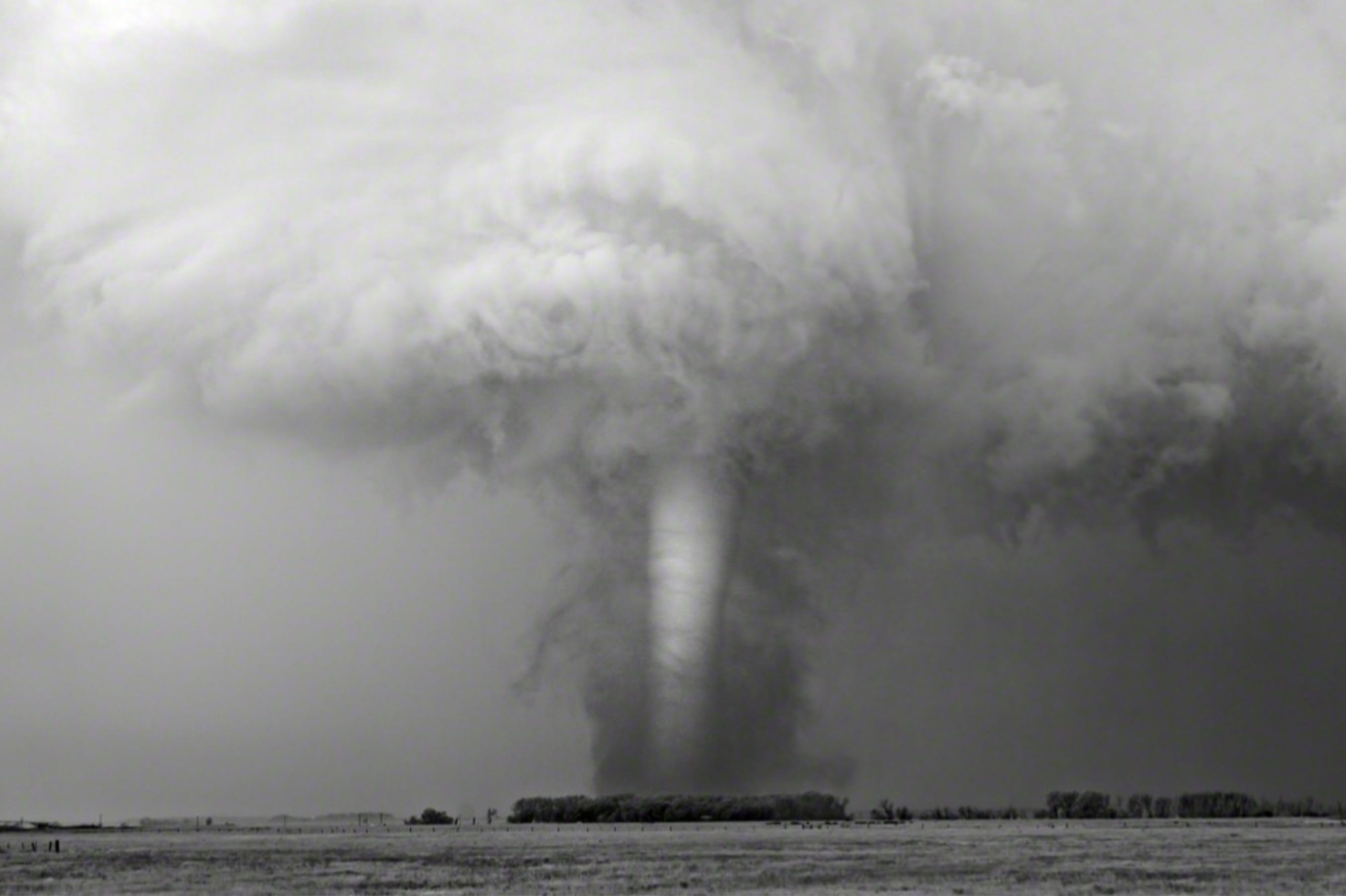
“My final product is really my prints,” he says. “Everything technically for me is focused on achieving the best prints that I can possibly achieve, and part of that process is the capture. I come from the wet darkroom and a black and white inkjet print at a certain quality is almost harder to achieve than a silver print. They’re different, for sure, but there’s a whole art to the printing process. The whole thing, from the beginning to the end, for me it’s all part of the process. The drive, the hunt, the capture, looking at it on a laptop in a tent, grading it, printing it, all the way to packing the print. I love the whole process.”
In terms of technique, photographing storms is unlike any other form of landscape photography. It is by definition a much faster experience than a meditative one. Dobrowner says it’s akin to action photography, with mere moments to make a picture.
“Being out in the southwest,” he says of traditional landscapes, “with the wind blowing in your face and nobody around, you’re watching the lighting and sitting quietly by yourself… I really enjoy that. Storm photography is a lot more like a sporting event. Because everything’s changing, almost second to second. Compositions are changing, lighting’s changing. It’s really taught me to focus. You can be in front of an amazing storm and you can blow an exposure, blow focus, lose your focus. It’s really taught me to extend into a different area.”
“It might be five minutes or 20 minutes or three minutes,” Dobrowner says. “But the thing is, you always have to think that you’re only going to be out there for three minutes. I have to be prepared to work quickly. The composition in front of you right now might be the best one you’re going to get. Or five seconds from now might be the best you’re going to get. Or 20 seconds from now.”
Unlike the typical landscape photographer who chooses a destination and waits for the light and the weather to convene, the storm photographer must go where the subject is. That may mean covering more ground in a day than most photographers would consider reasonable.
“In the six years I’ve been going out,” Dobrowner says, “we’ve traveled about 100,000 miles. So a 500 mile trip in one day is nothing. That’s about average. When we’re really pushing it we’re between 800 and 900 miles a day. Usually every year I go out a couple of times for a long trip. We pick a date and we don’t know what the weather’s going to be like, but we go. There’s always weather. We may start in Rapid City and end up in Amarillo, Texas. We go wherever the weather is. And you don’t know what it’s going to look like.”
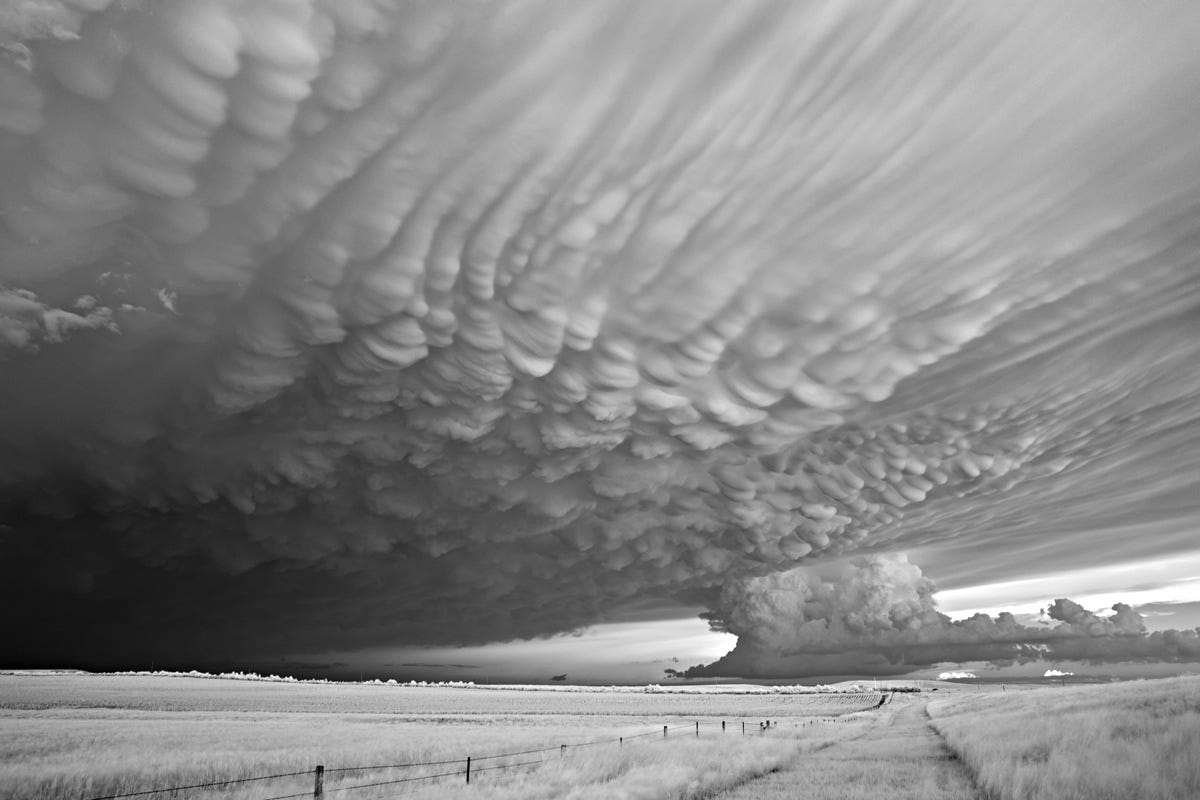
“You don’t have a choice,” he continues. “If the wall clouds are there at two in the afternoon, you need to be there, whatever the light is like. That’s the challenge. Even in my landscapes, before I go I usually have a picture in mind of what I want to photograph, but if the conditions are very different the challenge is still to make a good photograph. You don’t have control. That’s the thing with landscape photography that is so challenging.”
“I spend a lot of time just waiting,” he adds. “It’s discouraging, but it is part of the adventure. The good part with storms is nobody’s going to drop a tripod in the same place where I’ve dropped one to take a picture.”
Even supercell storms are dangerous, Dobrowner says he’s not particularly concerned for his safety and that photographing plain old landscapes is actually more dangerous.
“Compared to storms,” he says, “landscapes are much more challenging. I just came back from the maze out in Canyonlands, and just getting out there… The trekking and the hiking, the sweat and the blood and the dangers I find much more challenging than with storms. With storms there’s always a way to get out of the way, unless you’re being very foolish—which I’m trying not to be.”
“Everybody’s different,” he adds. “I’m not trying to be macho, but I do not get scared photographing storms. They are so beautiful, I’m more in awe of what I’m shooting. There’s no fear factor, and I’m out with somebody that I know is watching out. That’s the main reason I go out with someone else, so I can just stay concentrating on my photograph. I just listen for his voice in case he says we’ve gotta go, now.”
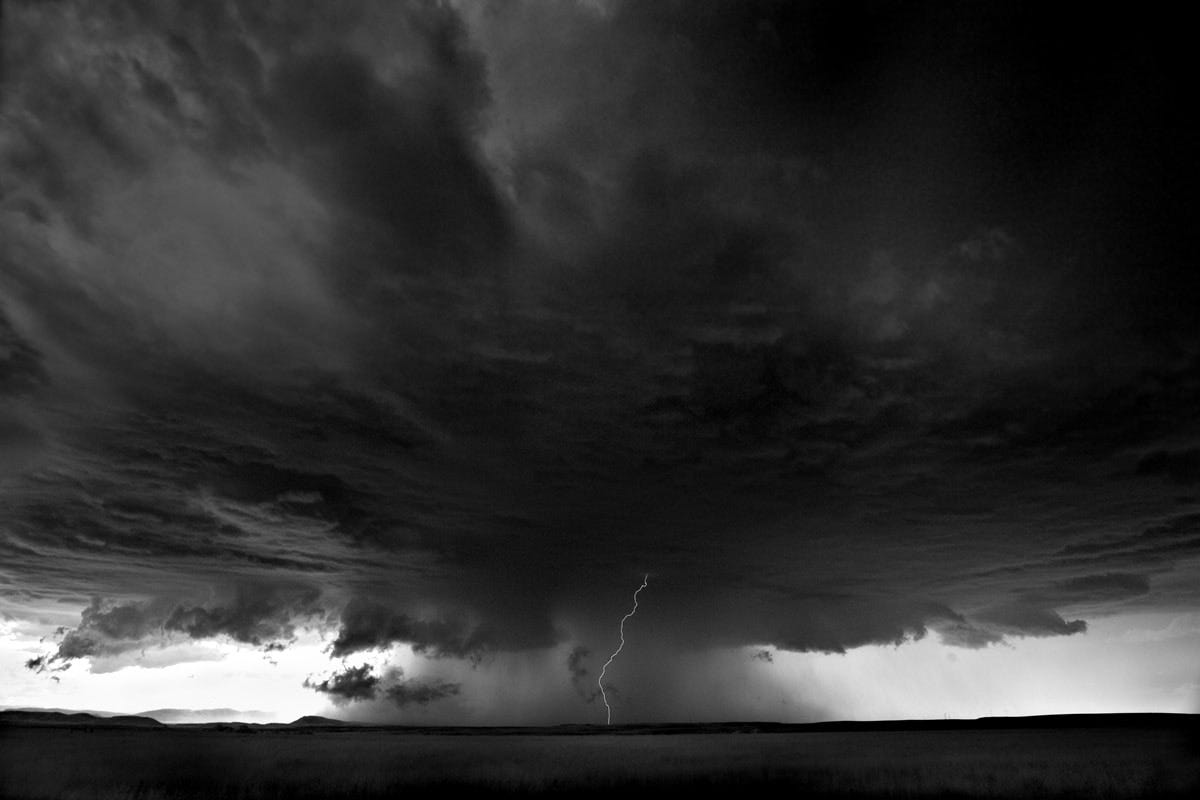
“We have a couple of minutes,” Dobrowner says of the usual storm. “You see the thing coming toward you and you get out of the way. Sometimes we can’t. There are people who have died, I don’t personally know them, but things happen. Things happen in photographing landscapes too. You’re hiking at four in the morning, up a thousand foot cliff, you misstep once and you’re off a ledge. You’re out in the dark just to get to a sunrise. Or you’re out for sunset in an extremely remote location, but you have to make it back to basecamp in the dark, scaling up and down rocks… There’s certain locations that I really want to photograph, they’re not just right off the highway. I can’t pull up the limo and just put my drink down. I find myself hiking up two or three miles, or scrambling down rocks… I love it, but it’s a challenge.”
Dobrowner says he thinks of his storm photographs like his children, each with a personality all its own. He loves them all and he remembers everything about them. Pressed for a favorite, he confesses that he’s proud of the perseverance that resulted in the image of a Shiprock storm.
“I saw the Shiprock picture in my mind before I went out,” he says, “but it took ten days to get it. It took a lot of energy and taught me a valuable lesson about tenacity. It’s almost like the location eventually says okay, I believe you’re for real. It’s about understanding the environment. The first couple of days I go out I usually don’t even photograph. Because I’m not in touch yet. I haven’t detoxed from Los Angeles yet. It’s almost like if I was a portrait photographer I’d want to spend some time with you and get to know you, not just knock on your door, take your picture and walk away.”
“I went with my son,” he continues. “We went to Garden of the Gods, the Ridge in Escalante… I just wasn’t happy with what I was getting. People might say they were good pictures, but it wasn’t what I’d envisioned. Driving home after ten days I wasn’t feeling good about what I’d photographed. That’s after all day photographing for ten days. We pulled off the road for a break and my son ran up the ridge and called back, ‘Dad, come here!’ I had my camera with me and that was the picture. It was almost the last picture I shot before we got home. I hadn’t ever really given up. I stayed tenacious. That’s what it takes to get a landscape picture.”
To see more of Mitch Dobrowner’s beautiful black and white photography, visit his website at mitchdobrowner.com
He is definitely a master craftsman. Great interview.